JAI HIND

JAI HIND

Monday, January 24, 2011

35 killed in SUSIDE BOMB ATTACK at MOSCOW- (RUSSIA) AIRPORT on 24/01/ 2011


A BRITON and other foreigners are among the 35 people killed in the Moscow airport bombing, the Interfax news agency quoted a security source as saying.
A spokesman for the British embassy said today he could not confirm the report but was "urgently" checking the information.

According to reports, two flights - one from British Airways and another from BMI - had arrived at Domodedovo international airport shortly before the blast, which has been blamed on a suicide bomber.
Separately, the Ministry of Health and Social Development reported on its website the list of those receiving hospital treatment included one man from Italy and another from France.
The Slovak embassy separately told the RIA Novosti news agency the actress, Zuzana Fialova, was also injured in the attack and was receiving treatment at a Moscow hospital.

RAHUL VALLAMBER

Thursday, January 20, 2011

IRAQ BOMB BLAST- 130 killed in a Car bomb attack on Iraqi pilgrims : 20-01-2011


BAGHDAD (AP) — Three suicide car bombers struck Shiite pilgrims south of Baghdad on Thursday, killing at least 130 people and wounding more than 180 in a third straight day of attacks across Iraq.
The string of assaults, reminiscent of the bloodiest days of the Iraq war, shattered a two-month lull and presented a major challenge to the new government of Prime Minister Nouri al-Maliki, who must soon decide whether to ask U.S. forces to stay after the end of the year.
Thursday's attacks were particularly significant because most of the victims were Shiite civilians, the government's core constituency. A lawmaker allied with anti-American cleric Muqtada al-Sadr, whose support for al-Maliki was crucial in enabling him to remain prime minister, accused government security forces of "not acting in a professional manner" to protect the pilgrims.
"I expect the attacks will continue ... due to the negligence of the security forces," the lawmaker, Hakim al-Zamili, told The Associated Press.
The attacks took place at mid-afternoon Thursday at three security checkpoints — one north and the two others south of Karbala, where millions of Shiite pilgrims are converging for rituals marking the 7th century death of Imam Hussein. He was a grandson of the Prophet Muhammad, who was slain near the city by Muslim rivals.
Ali Khamas, a pilgrim from the Shiite neighborhood of Sadr City in Baghdad, said he saw a car speeding toward one of the checkpoints, its driver refusing to stop despite warnings shouted by Iraqi soldiers.
"He sped up and blew up his car near the checkpoint," said Khamas, a 42-year-old truck driver. "After the explosion, people started to run in all directions, while wounded people on the ground were screaming for help. I saw several dead bodies on the ground."
The dead included a dozen Iraqi soldiers and policemen as well as an undisclosed number of women and children, officials said.
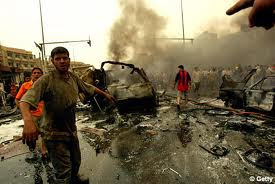
No group claimed responsibility, but suicide attacks are the trademark of the Islamic State of Iraq, an al-Qaida front group believed made up mostly of Sunni religious extremists.
Such groups have frequently targeted Shiite civilians, in part because of religious differences and because Shiite parties used their ties to the Americans to gain power after the 2003 U.S.-led invasion toppled Saddam Hussein's Sunni-dominated regime.
"The enemies always develop their tactics and improvise new plans to make use of any security breach," said Karbala provincial councilman Shadhan al-Aboudi. He blamed the blasts on al-Qaida and Saddam loyalists.
"They have apparently found a gap today in the security measures and they carried out an evil act against innocent believers who were practicing religious rituals," he said.
Since the end of Saddam's rule, Shiite politicians have encouraged huge turnouts at religious rituals, which were banned under the former regime as a demonstration of Shiite power.
Last month an alliance of Shiite parties took control of the government following elections in March, during which the Sunni-backed Iraqiya party won bragging rights by finishing first with a two-seat plurality.
With Iraqiya given a role in the new government, hopes were high that the Iraqis might be able to set aside sectarian ethnic and religious differences and begin the arduous task of rebuilding the country after nearly eight years of war.
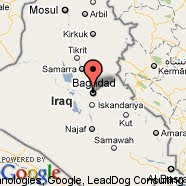
Those hopes began to fade Tuesday when a suicide bomber struck a group of young men seeking to join the police in the northern city of Tikrit, killing 65 people. The next day, a suicide bomber blasted a police compound in the eastern city of Baqouba, killing another three.
Al-Maliki adviser Adil Barwari said the attacks show extremists' determination "to undermine the new Iraqi government."
He also said the insurgents were trying to frighten neighboring countries from sending delegates to the Arab League summit in Baghdad in March — the first time Iraq has hosted the meeting in 20 years.
"They want it to fail," Barwari said. "But al-Qaida will not succeed in achieving this goal."
Although the government was formed a month ago, al-Maliki has yet to appoint ministers of defense, interior or national security, leaving him in charge of Iraq's entire security force. The attacks have increased pressure on al-Maliki, whose power base is in Karbala, to fill those positions — a task which will require hard-bargaining with the parties in his government because of the power those ministries wield.
"We have said more than once that the security situation is fragile and security violations will increase," said Amir al-Kinani, a Sadrist lawmaker. "The prime minister and other political blocs are responsible for these security violations. They have to take care of the situation."
If large-scale attacks continue, they will likely sharpen the political debate over whether to ask President Barack Obama to extend the presence of U.S. forces beyond the Dec. 31 deadline for their withdrawal set down in an agreement reached with the Iraqis in the final months of the Bush administration.
Al-Maliki has insisted that Iraqi forces are capable of maintaining security on their own, although it is widely assumed that his government will ask for at least some residual American presence despite opposition by the Sadrists and others in his government.
U.S. officials have said they would be willing to consider an Iraqi request to extend the American stay, but they want a decision by early spring in order to make plans for moving out the remaining 47,000 troops and equipment.
No such request has been made, and U.S. officials have said they would need to know by the summer if the Iraqis want a continued American presence.

SOURSE: Qassim Abdul-Zahra, Saad Abdul-Kadir and Yahya Barzanji in Baghdad and Sameer N. Yacoub in Amman, Jordan, contributed to this report.
Jai Hind
RAHUL VALLAMBER

Tuesday, December 28, 2010

INDIA ON RED ALERT over NEW YEAR 28-12-2010

India has issued a nationwide terror alert after receiving word that Pakistan-based militants are planning an attack over New Year's weekend. Officials have increased security in Mumbai, Goa, and Bangalore—specifically, at the Bombay Stock Exchange, Taj hotels in Mumbai, and software companies in Bangalore—and say that possible targets may include locations scouted out by American David Coleman Headley before the Mumbai attacks. Since Friday, Mumbai and Ahmedabad authorities have been hunting for four members of terrorist group Lashkar-e-Taiba believed to be in Mumbai and planning the attacks. Sketches have been released of the men, and police have stepped up security in public areas, and conducted house-to-house searches. Mumbai officials have not hesitated to issue terror alerts since the 2008 attacks left 166 people dead, and this is the third time this year that officials have issued a major warning.
New Delhi: The ministry of Home Affairs sounded a security alert across the country four days before the New Year festivities begin. The alert is specific for all locations that Lashkar agent David Coleman Headley recced. Information Bureau has picked up human intelligence which suggests that Taj Hotel could be attacked, following which security at all Taj Hotels, specially Mumbai's Taj Mahal hotel has been tightened.
The Home Ministry advisory came after a specific alert issued for Mumbai and Ahmedabad. Intelligence reports had suggested that terrorists from across the border have entered India with plans to attack Mumbai and Ahmedabad. Both Mumbai n Gujarat police have been asked to be vigilant. In Karnataka also, the threat of terror is raising concern.
Para military forces have been stationed in coastal Karnataka as inputs suggest terrorist could enter the state taking the sea route. Security forces in Goa too have been asked to be vigilant in the wake of the film festival and the rush of foreign tourists coming in for the New Year. People are advised to be vigilant and stay away from crowded places like markets and tourist places.

MUMBAI POLICE has released the sketches of four Lashkar-e-Taiba(LeT) suspects, who have reportedly sneaked into the city to carry out "violent" attacks with the aim of causing "destruction".

Issuing an advisory to citizens to remain alert, Joint Police Commissioner (Crime) Himanshu Roy told a news conference late on Thursday night that: "The four were identified as Abdul Kareem Moosa, Noor Abu Ilahi, Walid Jinnah and Mahfooz Alam. The four recently sneaked into the city to carry out extremely dangerous activity."

The police have set up dedicated phone number 02222633333 to enable the people pass on information about the militants and in the event of an emergency

JAI HIND
Rahul Vallamber

Sunday, December 26, 2010

Red Alert in MUMBAI-AHMEDABAD- sketch of LeT terrorist in Mumbai - 27-12-2010

The Mumbai police issued a terror advisory on Thursday night, after receiving intelligence inputs about four terrorists sneaking into the city ahead of the festive season.

Four members of Pakistan-based terror outfit Lashker-e-Tayiba sneaked into Mumbai, Joint Commissioner of Police (Crime) Himanshu Roy said on Thursday. The city police also released the sketch of one of the four suspected terrorists.

The four have been identified as Abdul Karim Musa, Noor Abu Ilahi, Walid Jinnah and Mahfooz Alam. The police have released the sketch of Walid Jinnah.

"We have information that they have arrived in Mumbai to carry out violent attacks intended to cause destruction," said Roy. He refused to divulge the nationality of the suspected terrorists.

Incidentally, the Centre had issued a terror advisory for Mumbai and Ahmedabad two days ago.

"The last time we had released sketches of terrorists was before Ganesh Chaturthi. Wide- publicity was given to the sketches due to which the festival passed off quite peacefully. This time too we want wide publicity so that people remain alert," said Roy.

He added that special teams of police officers would be keeping an eye on crowded places like railway stations and religious sites.

In case anyone has information on the four LeT terrorists, he/she can call up the Mumbai police's hotline at 22633333

Jai HInd
Rahul Vallamber

Tuesday, December 7, 2010

Indian Mujahideen claims responsibility for Varanasi blast (07/12/2010)

Terror group Indian Mujahideen Tuesday owned responsibility for a bomb explosion in Varanasi that killed a small girl and left 37 injured, saying it was to avenge the 1992 demolition of Ayodhya's Babri Masjid.
In an e-mail to media houses soon after the blast, the terror group said: "Indian Mujahideen attribute(s) this attack to the 6th of December that will haunt your nation of world's ‘greatest demoNcracy' until Muslims are paid back justly and fairly for the loss of their beloved Babri Masjid, the precious lives of their near and dear ones, their pride, dignity and self-respect."

The mail was sent from an e-mail ID alfateh00005@gmail.com.

The Indian Mujahideen, blamed for series of terror attacks in India, has been using unsecured WiFi connections for sending mails to media houses within minutes of the blasts in the last few years.

The home ministry said it was verifying the authenticity of the e-mail.

An official said investigative agencies were looking into and tracking the internet protocol (IP) address used to send the e-mail.

The security agencies say the Indian Mujahideen is supported by the Pakistan-based Lashkar-e-Taiba terror group.

The security agencies also believe that the Indian Mujahideen is one of many groups that has members from the banned Students Islamic Movement of India (SIMI).

The group claimed responsibility for the 2008 Jaipur bombings, Ahmedabad serial blasts and Delhi blasts.

Jai Hind
Rahul Vallamber

Blast at Varanasi's Dashashwamedh Ghat,1 killed and 37 injured on 07/12/2010

VARANASI: A two-year-old girl was killed and At least 37 people including four foreigners were injured in a blast at the Dashashwamedh Ghat here during the Ganga arati around 6.30pm on Tuesday. Many others were injured in the ensuing stampede. According to official sources, an Improvised Explosive Device (IED) has been recovered from a dustbin at the Varanasi blast site.


The girl identified as Sarita Sharma, who was with her mother for the prayers, died at Marwari hospital after the blast, according to IG(Varanasi) R P Singh. She was around two years, he said. It was not immediately known whether she suffered injuries in the explosion or in the stampede

The Ganga arati, which stretches across the Shitala, Dashashwamedh and Prayag ghats, is a daily ritual attended by 2,000 to 3,000 people, many of whom are foreigners. The ghats are near the famous Vishwanath temple.

A statewide alert has been sounded, ADG Brij Lal said.

The blast on Tuesday occurred on the stairs of Dashashwamedh ghat and was so powerful that big boulders on the stairs were thrown many metres away, eyewitnesses said.

The DIG of Varanasi range, Prem Prakash, said that the crowd was targeted. The injured have been taken to various hospitals in the city, including the district hospital.

The home ministry has sounded a nationwide alert with special stress on four major cities - Delhi, Mumbai, Bangalore and Hyderabad - in wake of the blast in Varanasi. "A general alert has been sent to all state governments and they have been asked to stay on high alert," Union Home Secretary G K .Pillai said in New Delhi.
"It was low intensity blast which occurred at about 6.20 pm in which three-four people were injured. Subsequently we understand there could have been a stampede...as a result 15-20 people were injured. So roughly 20-30 people injured," he said.
According to home ministry sources, alerts have been issued to the four metropolis in particular.
They said a high-level team of the National Investigation Agency is also likely to visit the holy town.
Secretary for Internal Security at MHA, U K Bansal said, "We had alerted Uttar Pradesh Police sometime back. I am sure the UP police will take it as a challenge. There is no reason for panic."


Jai Hind

Rahul vallamber

Monday, November 15, 2010

Karachi blast,13/11/2010


No CCTV evidence in Karachi blast, says official

Islamabad, Nov 13 (IANS) It would be difficult to track down the suspects in the Karachi port city blast Thursday that killed 19 people because electricity supply to the bombed police station was disconnected and there was no CCTV footage, an official said Saturday
.
Authorities Saturday, however, issued sketches of two suspects piecing together the information from eye-witnesses. They include a youngster of around 22 years of age and another man in his mid-30s, who were amongst the 10 terrorists who attacked the Karachi police station that housed the targeted criminal investigation department (CID) office.
Inspector General Sindh Police Salahuddin Babar Khattak said 'the attackers came on two motorbikes and one SUV jeep. They fired from two sides before carrying out the blast'.
Ahmad Chinoy, chief of the Citizen-Police Liaison Committee (CPLC)of Karachi, said: 'The Karachi Electric Supply Corporation (KESC) had disconnected the electricity of the CID police station a day before the blast, which meant that the CCTV cameras were not working when the explosion took place.'

'The lack of evidence in the form of CCTV footage has made it difficult for police authorities to find any clue about the suspected terrorists,' he said.
KESC spokesperson Ayesha Arabi, however, denied the claim and said the power supply was restored shortly afterwards.

Banned militant outfit Tehreek-i-Taliban claimed responsibility for the high-intensity attack, which also left over 140 people injured.

As many as 170 nearby houses were damaged in the attack while some offices situated on the same road have developed cracks.

The residents and the families of police officials killed in the blast are sitting at the debris and no alternative shelter has been provided to them as yet.

At least eight police officials patrolling the area were killed in the blast and the Sindh government has announced Rs.two million each and a plot in recognition of their sacrifice.
There have been reports in the media that six suspects arrested a couple of days before the blast for having links with Lashkar-i-Jhangvi were missing since the deadly suicide attack.
'The arms and ammunition of the police officials on duty as well as the suicide jackets recovered from the terrorists are also not being found,' a media report said.

'The exact situation will only be known after the removal of rubble,' said Javed Akram, superintendent of Sadar police.

Sindh Home Minister Zulfiqar Mirza said: 'We are in a state of war and such attacks should not deter us from our resolve to fight extremism.'

Chief Minister Qaim Ali Shah visited the blast site Saturday and said the terrorists could not entirely succeed in their designs after being stopped at the check-post. He said the new CID office will be built somewhere else instead of the busy downtown location.

An FIR has been registered against unknown attackers while the evidence collected initially has been sent to forensic lab.
Rahul vallamber