JAI HIND

JAI HIND

Monday, May 2, 2011

OSAMA Died and First Reaction In Pakistan with a bomb Blast 2/05/2011

AFTER EFFECT OF OSAMA DIED

4 killed, 10 injured in mosque blast in Charsadda, NW Pakistan


At least four people including three children and one woman were killed and 11 others were injured in a blast that ripped through a mosque Monday afternoon in northwest Pakistan, local television channels reported.According to local Urdu channel Geo News, the roadside explosion went off near the mosque in the limits of a police station in Charsadda, a city about 40 km northeast of Peshawar. Six to seven policemen were among the injured, some in critical condition.Security agencies cordoned off the area and the injured were shifted to the hospital where emergency was imposed. A bomb disposal squad was sent to the site and rescue operations were launched.The mosque was damaged in the blast. The wall of the nearby police station was also severely damaged.This area had earlier came under attack last month when the convoy of JUI-F party chief Maulana Fazlur Rehman was targeted.Security in the area was beefed up earlier in the morning when news about al-Qaida chief Osama bin Laden's death spread out. Local media reports said the al-Qaida-linked Taliban have vowed more suicide attacks across Pakistan, even against the country's president Asif Ali Zardari.


Jai Hind

Rahul Vallamber

osama bin laden died

U.S. President Barack Obama was preparing to announce Osama bin Laden was dead when word got out and crowds started gathering late Sunday outside the White House in Washington and at Ground Zero in New York City.
From Times Square to Ground Zero to the White House, the familiar chant of "USA , USA" resonated as citizens learned that the Osama bin Laden was dead.

The announcement sparked immediate jubilation. In Time Square, people gathered around giant news tickers to see the latest updates. Pam Sather recalls the moment she heard the world's most wanted terrorist was dead.

"It is just amazing, we were just walking out of a pizza joint," she said. "And, all the sudden we saw in the bar on the television. We were just glued." A firefighter waves to the crowd as people celebrate after Al Qaeda leader Osama bin Laden was killed in Pakistan, during a spontaneous celebration in New York's Times Square, May 2, 2011

At the White House, young Americans climbed trees, climbed light posts, donned American flags and sang the national anthem.

The feeling was euphoric as thousands of Americans gathered in front of the White House just hours after U.S. President Barack Obama made the announcement that Osama bin Laden was dead.

For many, including student Kathryn Costello, it became a moment of reflection, thinking back to the nearly 3,000 lives lost on September 11, 2001, an act of terror Osama bin Laden claimed responsibility for.

"I think a lot of us have grown up with the memory of 9/11 and sort of this constant notion of a threat and the danger of terrorism," said Costello. "So this is a triumphant moment for all of us."

For many U.S. soldiers, including U.S. Marine Jake Diliberto, this is a day they have been fighting for.

"We feel really really vindicated that we finally got him," he said. "This is our generation's VE, VJ. This is our generation's victory and enduring freedom day."

Patriotism filled the air outside the White House into the early hours Monday.

Two hours after the announcement, with celebrations still roaring, the U.S. Secret Service brought in barriers to push back revelers from the White House.

International student Sunny Shih said the importance of the historical moment reaches beyond the gates of the White House.
"This is a very important moment for not only the U.S.A., but for the entire world," said Shih.

Many world leaders are praising the achievement of U.S. military forces Sunday in Pakistan, who killed Osama bin Laden, captured his body and buried it at sea. But they are cautioning bin Laden's death elevates security risks around the world.

Back at the White House, the focus remains on the justice the president said was delivered.

Jai Hind
Rahul Vallamber

Wednesday, March 16, 2011

5 hurt in grenade attack in Guwahati, on 14/03/ 2011


Guwahati, Mar 14(NNN): A grenade attack on the Assam Pradesh Congress Committee (APCC) headquarters in Guwahati on Monday evening left at least five persons injured.
The anti-talks group of the outlawed United Liberation Front of Asom (ULFA) has claimed responsibility for the attack.
Senior police officials aren’t sure what caused the blast at the APCC media cell near the entrance gate of Rajiv Bhavan at 6.55 pm. “It could have been a grenade lobbed by some passersby or, going by the intensity and sound, a remote-controlled IED,” said an officer. But DGP Sankar Barua said it was too early to ascertain the cause. “We hope to catch the culprits after a thorough investigation,” he added.
The blast damaged much of the media cell leaving spokesperson Mehdi Alam Bora and a security guard bleeding profusely. They were rushed to the Guwahati Medical College Hospital while APCC general secretary Ranjan Bora and spokespersons Kalyan Gogoi and Akshoy Rajkhowa escaped with minor injuries.
The ULFA had during Prime Minister Manmohan Singh’s visit in February threatened to target Congress leaders and members in poll-bound Assam. “The Congress needs to be taught a lesson for splitting our organization,” said the outfit’s military chief Paresh Barua from somewhere on the Myanmar-China border.
The outfit showed it meant business by attacking a Congress gram panchayat leader in eastern Assam’s Tinsukia district last month and following it up with a grenade attack on a Congress office in Golaghat district.

jai hind
Rahul Vallamber

Wednesday, February 9, 2011

Suicide attack kills 21 and 20 injured at MARDAN,Pakistan military event on 10/02/2011

MARDAN, Pakistan — A suicide attack killed 21 people and 20 people injured at a Pakistan military parade in the country's northwest on Thursday, where the Taliban have vowed to step up attacks on security forces, officials said.
There was no immediate claim of responsibility, but the Taliban have vowed to step up attacks on Pakistani security forces in the region to avenge a fresh offensive against Islamist sanctuaries in the tribal district of Mohmand.


"It was a suicide attack. The teenager bomber was on foot and was wearing a school uniform," Abdullah Khan, a senior police officer in the city of Mardan, around 30 kilometres (20 miles) from the regional capital Peshawar, told AFP.
"21 soldiers were killed on the spot and one in hospital. twenty others have been injured," he said. Two military officials in Peshawar confirmed the suicide attack and the death toll.
Mardan is some 50 kilometres east of Mohmand tribal district where Pakistan launched an offensive last month and officials said that a surge in bomb and suicide attacks was a reaction to the operation.
Some 25,000 people have fled in just a week from Mohmand tribal zone, a UN official said last week.
Pakistan suffers near-daily attacks blamed on Taliban and Al-Qaeda-linked militants that have killed more than 4,000 people since government troops evicted Islamists from an Islamabad mosque in a deadly July 2007 siege.
Local Taliban, who are fiercely opposed to the US-allied government, recently vowed to step up attacks on Pakistani police and security forces.
Pakistan's northwest and tribal areas have been wracked by violence, mostly targeting security officials, since hundreds of Taliban and Al-Qaeda fighters sought refuge there after the US-led invasion of Afghanistan in 2001.
The military has claimed victory in a number of battles against militants, perhaps most notably in 2009 in the Taliban's former headquarters of South Waziristan, but attacks have continued across the country.
Washington has said eliminating militant sanctuaries in Pakistan's tribal belt, particularly North Waziristan, is vital to winning the war against the Taliban in Afghanistan and defeating Al-Qaeda

RAHUL VALLAMBER

8 killed and 35 injured in a Car Bomb Blast at KIRKUK, Iraq on 09/02/2011

KIRKUK, Iraq — Three near-simultaneous car bombs killed at least 8 people and in the ethnically-divided northern city of Kirkuk on Wednesday, attacks blamed on Sunni militant group Ansar Al-Islam. More then 35 of others were wounded in the triple blasts at around 10:25 am (0725 GMT) in the west of the oil-rich city, which is at the centre of a major land dispute between Iraq's central government and its autonomous Kurdish region.
"We are certain that this terrorist group, Ansar Al-Islam, is behind this attack," Kirkuk province police chief Major General Jamal Taher Bakr told AFP.
"Our security forces will punish that group, because they have targeted all the people of Kirkuk. They are trying to raise sectarianism but they will fail, as they failed before."
Bakr said the three explosions killed eight people and left 104 others wounded. Sadiq Omar Rasul, the head of the province's health department, earlier put the toll at eight killed and 68 injured.
The police chief said the three blasts included a car bomb driven by a suicide attacker which struck the office of asayesh forces, or Kurdish internal security, loyal to the Kurdistan Democratic Party of Kurdish regional president Massud Barzani.
He said the second car bomb struck a police patrol in the same west Kirkuk neighbourhood as the first, while a third vehicle packed with explosives detonated nearby targeting the convoy of a senior police officer.
Police Major Salam Zangana, who said eight people were killed and 83 wounded in the attacks, added that a woman, a child and two policemen were among the dead.
Ansar al-Islam is a Sunni militant group created in 2001 by veterans of the 1980s Soviet war in Afghanistan and had its headquarters in Iraqi Kurdistan, near the border with Iran.
Shortly before the US-led invasion of Iraq in 2003, US special forces and fighters from Iraqi President Jalal Talabani's Patriotic Union of Kurdistan fought Ansar al-Islam, whose fighters fled their headquarters.
In September 2003, many Ansar al-Islam members formed the soon-to-be renowned militant group Ansar al-Sunna.
Kirkuk, 240 kilometres (150 miles) from Baghdad, is populated by a mix of Arabs, Kurds and Turkmen, and is the capital of the province of the same name.
It is at the centre of a tract of disputed territory claimed by the central government in Baghdad as well as Kurdish authorities in the north, who want it incorporated into their autonomous region.
US military officials have said the unresolved land dispute is a key threat to Iraq's future stability, and tensions across the area have led some analysts to dub the border between the two sides the "trigger line."

Rahul Vallamber

Monday, January 24, 2011

35 killed in SUSIDE BOMB ATTACK at MOSCOW- (RUSSIA) AIRPORT on 24/01/ 2011


A BRITON and other foreigners are among the 35 people killed in the Moscow airport bombing, the Interfax news agency quoted a security source as saying.
A spokesman for the British embassy said today he could not confirm the report but was "urgently" checking the information.

According to reports, two flights - one from British Airways and another from BMI - had arrived at Domodedovo international airport shortly before the blast, which has been blamed on a suicide bomber.
Separately, the Ministry of Health and Social Development reported on its website the list of those receiving hospital treatment included one man from Italy and another from France.
The Slovak embassy separately told the RIA Novosti news agency the actress, Zuzana Fialova, was also injured in the attack and was receiving treatment at a Moscow hospital.

RAHUL VALLAMBER

Thursday, January 20, 2011

IRAQ BOMB BLAST- 130 killed in a Car bomb attack on Iraqi pilgrims : 20-01-2011


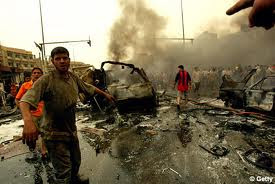
BAGHDAD (AP) — Three suicide car bombers struck Shiite pilgrims south of Baghdad on Thursday, killing at least 130 people and wounding more than 180 in a third straight day of attacks across Iraq.
The string of assaults, reminiscent of the bloodiest days of the Iraq war, shattered a two-month lull and presented a major challenge to the new government of Prime Minister Nouri al-Maliki, who must soon decide whether to ask U.S. forces to stay after the end of the year.
Thursday's attacks were particularly significant because most of the victims were Shiite civilians, the government's core constituency. A lawmaker allied with anti-American cleric Muqtada al-Sadr, whose support for al-Maliki was crucial in enabling him to remain prime minister, accused government security forces of "not acting in a professional manner" to protect the pilgrims.
"I expect the attacks will continue ... due to the negligence of the security forces," the lawmaker, Hakim al-Zamili, told The Associated Press.
The attacks took place at mid-afternoon Thursday at three security checkpoints — one north and the two others south of Karbala, where millions of Shiite pilgrims are converging for rituals marking the 7th century death of Imam Hussein. He was a grandson of the Prophet Muhammad, who was slain near the city by Muslim rivals.
Ali Khamas, a pilgrim from the Shiite neighborhood of Sadr City in Baghdad, said he saw a car speeding toward one of the checkpoints, its driver refusing to stop despite warnings shouted by Iraqi soldiers.
"He sped up and blew up his car near the checkpoint," said Khamas, a 42-year-old truck driver. "After the explosion, people started to run in all directions, while wounded people on the ground were screaming for help. I saw several dead bodies on the ground."
The dead included a dozen Iraqi soldiers and policemen as well as an undisclosed number of women and children, officials said.
No group claimed responsibility, but suicide attacks are the trademark of the Islamic State of Iraq, an al-Qaida front group believed made up mostly of Sunni religious extremists.
Such groups have frequently targeted Shiite civilians, in part because of religious differences and because Shiite parties used their ties to the Americans to gain power after the 2003 U.S.-led invasion toppled Saddam Hussein's Sunni-dominated regime.
"The enemies always develop their tactics and improvise new plans to make use of any security breach," said Karbala provincial councilman Shadhan al-Aboudi. He blamed the blasts on al-Qaida and Saddam loyalists.
"They have apparently found a gap today in the security measures and they carried out an evil act against innocent believers who were practicing religious rituals," he said.
Since the end of Saddam's rule, Shiite politicians have encouraged huge turnouts at religious rituals, which were banned under the former regime as a demonstration of Shiite power.
Last month an alliance of Shiite parties took control of the government following elections in March, during which the Sunni-backed Iraqiya party won bragging rights by finishing first with a two-seat plurality.
With Iraqiya given a role in the new government, hopes were high that the Iraqis might be able to set aside sectarian ethnic and religious differences and begin the arduous task of rebuilding the country after nearly eight years of war.
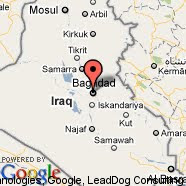
Those hopes began to fade Tuesday when a suicide bomber struck a group of young men seeking to join the police in the northern city of Tikrit, killing 65 people. The next day, a suicide bomber blasted a police compound in the eastern city of Baqouba, killing another three.
Al-Maliki adviser Adil Barwari said the attacks show extremists' determination "to undermine the new Iraqi government."
He also said the insurgents were trying to frighten neighboring countries from sending delegates to the Arab League summit in Baghdad in March — the first time Iraq has hosted the meeting in 20 years.
"They want it to fail," Barwari said. "But al-Qaida will not succeed in achieving this goal."
Although the government was formed a month ago, al-Maliki has yet to appoint ministers of defense, interior or national security, leaving him in charge of Iraq's entire security force. The attacks have increased pressure on al-Maliki, whose power base is in Karbala, to fill those positions — a task which will require hard-bargaining with the parties in his government because of the power those ministries wield.
"We have said more than once that the security situation is fragile and security violations will increase," said Amir al-Kinani, a Sadrist lawmaker. "The prime minister and other political blocs are responsible for these security violations. They have to take care of the situation."
If large-scale attacks continue, they will likely sharpen the political debate over whether to ask President Barack Obama to extend the presence of U.S. forces beyond the Dec. 31 deadline for their withdrawal set down in an agreement reached with the Iraqis in the final months of the Bush administration.
Al-Maliki has insisted that Iraqi forces are capable of maintaining security on their own, although it is widely assumed that his government will ask for at least some residual American presence despite opposition by the Sadrists and others in his government.
U.S. officials have said they would be willing to consider an Iraqi request to extend the American stay, but they want a decision by early spring in order to make plans for moving out the remaining 47,000 troops and equipment.
No such request has been made, and U.S. officials have said they would need to know by the summer if the Iraqis want a continued American presence.

SOURSE: Qassim Abdul-Zahra, Saad Abdul-Kadir and Yahya Barzanji in Baghdad and Sameer N. Yacoub in Amman, Jordan, contributed to this report.
Jai Hind
RAHUL VALLAMBER