JAI HIND

JAI HIND

Monday, November 15, 2010

Karachi blast,13/11/2010


No CCTV evidence in Karachi blast, says official

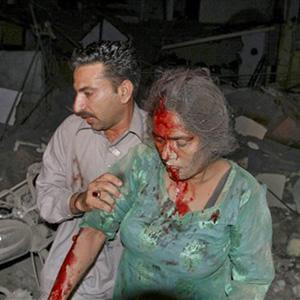
Islamabad, Nov 13 (IANS) It would be difficult to track down the suspects in the Karachi port city blast Thursday that killed 19 people because electricity supply to the bombed police station was disconnected and there was no CCTV footage, an official said Saturday
.
Authorities Saturday, however, issued sketches of two suspects piecing together the information from eye-witnesses. They include a youngster of around 22 years of age and another man in his mid-30s, who were amongst the 10 terrorists who attacked the Karachi police station that housed the targeted criminal investigation department (CID) office.
Inspector General Sindh Police Salahuddin Babar Khattak said 'the attackers came on two motorbikes and one SUV jeep. They fired from two sides before carrying out the blast'.
Ahmad Chinoy, chief of the Citizen-Police Liaison Committee (CPLC)of Karachi, said: 'The Karachi Electric Supply Corporation (KESC) had disconnected the electricity of the CID police station a day before the blast, which meant that the CCTV cameras were not working when the explosion took place.'

'The lack of evidence in the form of CCTV footage has made it difficult for police authorities to find any clue about the suspected terrorists,' he said.
KESC spokesperson Ayesha Arabi, however, denied the claim and said the power supply was restored shortly afterwards.

Banned militant outfit Tehreek-i-Taliban claimed responsibility for the high-intensity attack, which also left over 140 people injured.

As many as 170 nearby houses were damaged in the attack while some offices situated on the same road have developed cracks.

The residents and the families of police officials killed in the blast are sitting at the debris and no alternative shelter has been provided to them as yet.

At least eight police officials patrolling the area were killed in the blast and the Sindh government has announced Rs.two million each and a plot in recognition of their sacrifice.
There have been reports in the media that six suspects arrested a couple of days before the blast for having links with Lashkar-i-Jhangvi were missing since the deadly suicide attack.
'The arms and ammunition of the police officials on duty as well as the suicide jackets recovered from the terrorists are also not being found,' a media report said.

'The exact situation will only be known after the removal of rubble,' said Javed Akram, superintendent of Sadar police.

Sindh Home Minister Zulfiqar Mirza said: 'We are in a state of war and such attacks should not deter us from our resolve to fight extremism.'

Chief Minister Qaim Ali Shah visited the blast site Saturday and said the terrorists could not entirely succeed in their designs after being stopped at the check-post. He said the new CID office will be built somewhere else instead of the busy downtown location.

An FIR has been registered against unknown attackers while the evidence collected initially has been sent to forensic lab.
Rahul vallamber

Thursday, September 23, 2010

Terror mail sent by INDIAN MUJAHIDEEN to BBC (19/09/2010)


NEW DELHI: Investigations into the terror email sent by Indian Mujahideen (IM) hours after the Jama Masjid firing incident have revealed that a second-hand Nokia mobile handset purchased from a shop in Dongri in south Mumbai was used to send the threat mail.

However, the shopkeeper has no records of the person who bought the handset. Investigators believe that the terrorist bought a second-hand mobile to reduce the chances of getting traced.

A Tata Docomo prepaid mobile number — 897XXXX165 — registered at a fake Borivili address in the name of a woman was used to send the email on Sunday. "Analysis of the SIM card has further revealed that it was activated on September 14-15 and was not used for sending any message or email. It only contains welcome message from Tata Indicom. The GPRS which was used to send the email was activated on September 15. From the usage, it appears that it was a high-end handset," said a Mumbai ATS official.

A Delhi Police team, which is seeking help of Mumbai police has not made any headway from the email though it questioned the two men who sold the mobile and SIM card. Cops said that they are still awaiting the forensic report on the e-mail contents.

"It appears that the e-mail id — al.arbi999123@gmail.com — was created and then the IM mail was saved in the drafts. The email was created using a laptop or a desktop. The gmail ID was opened on the mobile at in Dongri and then the mail sent to media houses," said an officer.

Jai Hind
Rahul Vallamber

'Delhi attack on 19/09/2010'

The September 19 attack on foreigners near the Jama Masjid in New Delhi, days before the Commonwealth Games open in the capital, has created a scare in India and abroad.
Australia has issued a travel advisory to its citizens not to travel to India.
Justine Bowden, whose company Beltin Group will provide advisory and security to the Australian media during the CWG, says the delay in infrastructure development has affected the ability of counter-terrorism teams to train and plan contingencies for the sites.
In this interview Dr Bowden speaks about Sunday's attack at Delhi and what the thinking is in the Australian team, which is on its way to attend the Commonwealth Games.

Investigation into the Jama Masjid attack on Sunday have found that the email ID, al.arbi999123@gmail.com, which was used to send the mail to BBC after the incident was created using a California IP address. The Delhi Police have also tracked down another IP address in Mumbai.
Sources said the email ID was created using the United States IP address a few minutes before the blast. “The person then conveyed the ID and password to the email sender in Mumbai. The person in Mumbai then sent the mail using a Tata Photon Internet card that was procured on a fake identity,” said sources.
The Delhi Police are in the process of sending a letter rogatory (LR) to the US to seek information from Google on the person who created the email ID. Officials said they would ask the ministry of external affairs to expedite the request.
Sources said the Tata Photon card used to send the mail has not been traced yet. The dealer from whom the card has been procured has been traced to Dadar area in Mumbai. The Mumbai Police, with the help of the internet card dealer, have prepared a sketch of the person who purchased the card.
Meanwhile, a forensic team of the Delhi Police today visited the Jama Masjid spot where the incident occurred. Officials said four empty cartridges are yet to be recovered.

Jai Hind
Rahul Vallamber

Thursday, July 1, 2010

41 killed in explosions at shrine in Lahore, Pakistan 01/07/2010


Islamabad, Pakistan -- Three explosions erupted Thursday in Lahore in and around one of Pakistan's holiest shrines, killing 41 people and wounding 175, an official told CNN.
District Coordination Officer Sajjad Bhutta in Lahore described the casualty toll as he was touring hospitals where the wounded were being treated.
Lahore Commissioner Khusro Pervez said 25 of the wounded were in critical condition and that the remains of two suicide bombers -- a man in his 20s and another in his late teens -- were recovered after the blasts, which occurred at the Data Darbar shrine complex.
One of the bombers detonated in the shrine's courtyard; the other in the shrine's lower lever, he said. Two of the fatalities were women, he said.
The first explosion, which occurred at 10:48 p.m. (1:48 p.m. ET), was followed five minutes later by a second blast, Geo TV reported.
The CNN affiliate aired surveillance footage showing the first attacker entering through a gate holding a bag. As he passed through a metal detector, alarms went off and the man ran toward an area used for ablutions and blew himself up.
Geo TV showed a second attacker entering amid the confusion a few minutes later and running upstairs carrying a bag. Then the video showed the explosion.
The third blast occurred outside the shrine; the timing of the last blast was not clear.
Geo TV reported that the heads of two bombers were recovered and identified. The bombers had arrived at the shrine on foot wearing 10 kilogram (22 pound) jackets that had been packed with ball bearings, it said.
A witness told Geo TV that one of the bombers was wearing the traditional loose-fitting salwar kameez, a turban and slippers.
"This sickening poison of extremism will be driven out of our nation and we will not be cowed," said Farahnaz Ispahani, a spokeswoman for President Asif Ali Zardari, in a text message to CNN.
"Peaceful worshipers have once again been targeted by those who want to destroy the fabric of this great country. We will not forgive or forget and we will get justice for all Pakistanis murdered in cold blood -- be they Muslim, Christian, Ahmedi or of any other faith."

Source BY GEO/CNN TV NEWS
Jai Hind
Rahul Vallamber

Recent Naxal Attacks In The Country

Following is the chronology of major recent Naxal attacks in the country.

June 29,2010: 27 CRPF jawans were killed by Naxalites in Chhattisgarh, comes as the CPI-Maoist vowed to continue attacking security forces.

May 16, 2010: Six villagers were killed by Naxalites in Rajnandgaon district of Chhattisgarh. Among those killed was the sarpanch of the village.

April 6, 2010: In the country's worst Maoist attack ever, at least 75 Central Reserve Police Force (CRPF) and a state police personnel were killed in an ambush, in the thick Mukrana forests of Chhattisgarh's Dantewada district.

April 4, 2010: Maoists triggered a landmine blast killing 11 security personnel of the elite anti-Naxal force Special Operations Group (SOG) in Koraput district of Orissa.

February 15, 2010: 24 personnel of the Eastern Frontier Rifles (EFR) killed as Maoists attack their camp in Silda in West Midnapore district of West Bengal.

October 8, 2009: 17 policemen killed when Maoists ambushed them at Laheri police station in Gadchiroli district of Maharashtra.

September 30, 2009: Naxalites set ablaze Gram Panchayat offices at Korchi and Belgaon in Gadchiroli district of Maharashtra.

September 26, 2009: Naxals kill BJP MP from Balaghat Baliram Kashyap's sons at Pairaguda village in Jagdalpur (Chhattisgarh).

September 4, 2009: Naxals kill four villagers in a forest in Aaded village in Chhattisgarh's Bijapur district.

July 31, 2009: A special police officer and another person killed by Naxals in Bijapur district.

July 27, 2009: Six persons killed when Naxals trigger a landmine blast at Dantewada district in Chhattisgarh.

July 23, 2009: A 40-year-old tribal killed by Naxalites at Ettapalli taluka in Gadchiroli district.

Jai Hind
Rahul Vallamber

27 CRPF JAWANS killed By Naxilites, 29/06/10


In the wake of repeated attacks by Maoists on CRPF, the government is working out a plan for the redeployment of paramilitary forces engaged in anti-Naxal operations in states.

The development, two days after Naxals ambushed and killed 27 CRPF jawans in Chhattisgarh, comes as the CPI-Maoist vowed to continue attacking security forces.
"We will continue to hit hard security personnel because their atrocities against local innocent people are continuing," Gudsa Usendi, spokesperson of CPI-Maoist's frontal unit, DK Special Zonal Committee, told a news channel in Chhattisgarh from an undisclosed location.

The spokesperson refused to give details about the June 29 attack that left 27 security personnel dead in Narayanpur district, a part of 40,000 sq km restive Bastar region.

The guerrilla evaded questions such as how many Maoists were killed, how many rebels took part in the ambush, who led the attack, and how many and what kind of weapons the Maoists had looted from the slain men.


"The June 29 attack was part of Maoists' continuous retaliation against police atrocities on locals," he said.

A plan is now being worked out for reconfiguration, redeployment and strengthening of the paramilitary forces in Chhattisgarh, Jharkhand, Orissa and West Bengal phasewise in consultation with the state governments.

"It has become necessary to review the deployment of forces and a suitable decision will be taken according to the operational requirement and developmental reasons," a Home Ministry official said.

However, no central forces deployed in a particular state will be moved out from that state.

According to the plan, which will be implemented first in Chhattisgarh where CRPF has faced maximum casualties in the recent past, the distances of troop posts will be reduced and in some cases the number of personnel will be increased while in other cases the posts will be relocated.

After Chhattisgarh, the plan will be implemented in Jharkhand, Orissa and West Bengal.

Home Minister P Chidambaram had yesterday said that "relocation and reconfiguration" of paramilitary forces in Chhattisgarh may be required as some of them were not operationally viable.

"These deployments have been made in 2007 and 2008. So, I have asked the Chhattisgarh government to examine the deployments in 2010," he had said.

Chhattisgarh police to adopt aggressive strategy' Chhattisgarh police will adopt an aggressive strategy while dealing with the Naxalites in the wake of increasing attacks by the outlaws, State Home Minister Nanki Ram Kanwar said today.

The police will adopt an aggressive stance against Naxals and will try to eliminate them rather than risking their lives, Kanwar told reporters here.

A change in strategy has been necessitated following three major strikes in the State in which the lives of many jawans were lost, he said.

Kanwar said Chief Minister Raman Singh held a high level meeting to discuss the issue but refused to divulge further details.

Jai hind
Rahul Vallamber

Tuesday, May 11, 2010

Iraq bomb blast: 120 killed in series of explosions on 10th may 2010


BOMB EXPLOSIONS(10/05/2010) in the streets of Bagdad lost its news value, if the death toll is in tens. But when it touches hundred, the story is altogether different. Monday began with series of blast across Iraq killing at least 100 people and injuring hundreds. This is deadliest day of this year so far.
Three bombs hit the southern Shiite port city of Basra in the evening. One of them exploded in market place killing at least 15 people. The day began with the killing of 10 people in capital in an co-ordinate attack.


The most deadly incident took place in city of Hillah, 95 km south of Bagdad. A suicide bomber blew himself up among the crowd trying to help the victim of two car bombs that went off earlier outside a textile factory.


Official in hospital said that at least 120 people are dead and more than 170 are seriously injured.

The government blamed al-Qaida in Iraq for violence in Baghdad, saying the terror group is stepping up its attacks now to exploit political instability. More than two months after the March 7 elections, it is not clear who will control the next Iraqi government and the U.S. is planning to pull out half of its 92,000 troops over the next four months.


Tall claims by Iraqi and U.S forces about the security seem to be nothing but self-satisfactory lies. This scale of violence is clear reminder of the fact that the ultras are still very active and they can topple nay government in just few months time.

There is no immediate claim of responsibility; leaders are blaming al-Qaida for this kind of attacks, saying the group is attempting to exploit Iraq’s political instability. Compared to 2006-07 the violence has fallen dramatically in recent past, but political vacuum in the wake of inconclusive election has raised the risk of sectarian violence.

In another twin explosion in Suwayrah, 40 km south of Bagdad, 11 people died and dozens are seriously wounded.

Follwing the chain of blast, third blast occurred in Tarmiyah city, 50 km north of Bagdad. This blast injured the Mayor of the city, killed five, and injured seven. More than six people died in one such bomb explosion in city of Abu Gharib, west of Bagdad.

Whoever is the killer, whatever is the purpose, but this total tally of one less then 100 clearly shows that the Iraqi mission is total failure except Saddam.

Jai Hind

Rahul Vallamber